
The silence that falls over a garden party when the last tray of Chicken Satay is emptied far too early is a sound no host ever wants to hear. It is a deeply personal fear, rooted in the desire to be a generous provider for those we care about. Whether you are planning a corporate lunch in the city or a milestone birthday at home, the question of how much food to order for catering often brings more stress than joy. You want your guests to experience the rich, aromatic heart of a communal feast, but the confusion over differing portion sizes and the dread of social embarrassment can make the planning process feel overwhelming.
We believe that every event should feel like an invitation into a welcoming home, where the abundance of flavour is matched only by the ease of the experience. This guide will help you master the art of catering quantities for 2026, ensuring you provide a satisfying spread that respects your budget and avoids unnecessary waste. We will walk you through a foolproof formula for ordering, from calculating piece counts for Malaysian heritage dishes to balancing a menu that caters to all dietaries with confidence and grace. By the end, you will have the clarity needed to host an unforgettable gathering where every guest leaves with a full heart and a satisfied appetite.
Key Takeaways
- Discover how to find the “Goldilocks Zone” of catering, ensuring your guests are perfectly satisfied without the frustration of excessive food waste or lost money.
- Learn the specific “Protein-to-Carb” ratios required for communal feasts so you know exactly how much food to order for catering when serving rice-based heritage dishes.
- Understand how the time of day dictates your menu, from light aromatic morning tea bites to the heartier Nasi Lemak Ayam Rempah needed for a productive “Power Lunch”.
- Navigate the modern Australian dietary landscape with ease by choosing authentic Malaysian dishes that are naturally Halal-friendly and often gluten-free.
- Gain the confidence to host a professional event that feels like a warm family gathering by utilising time-honoured recipes from Penang and Kelantan.
The Fundamentals of Catering Quantities: Why the Maths Matters
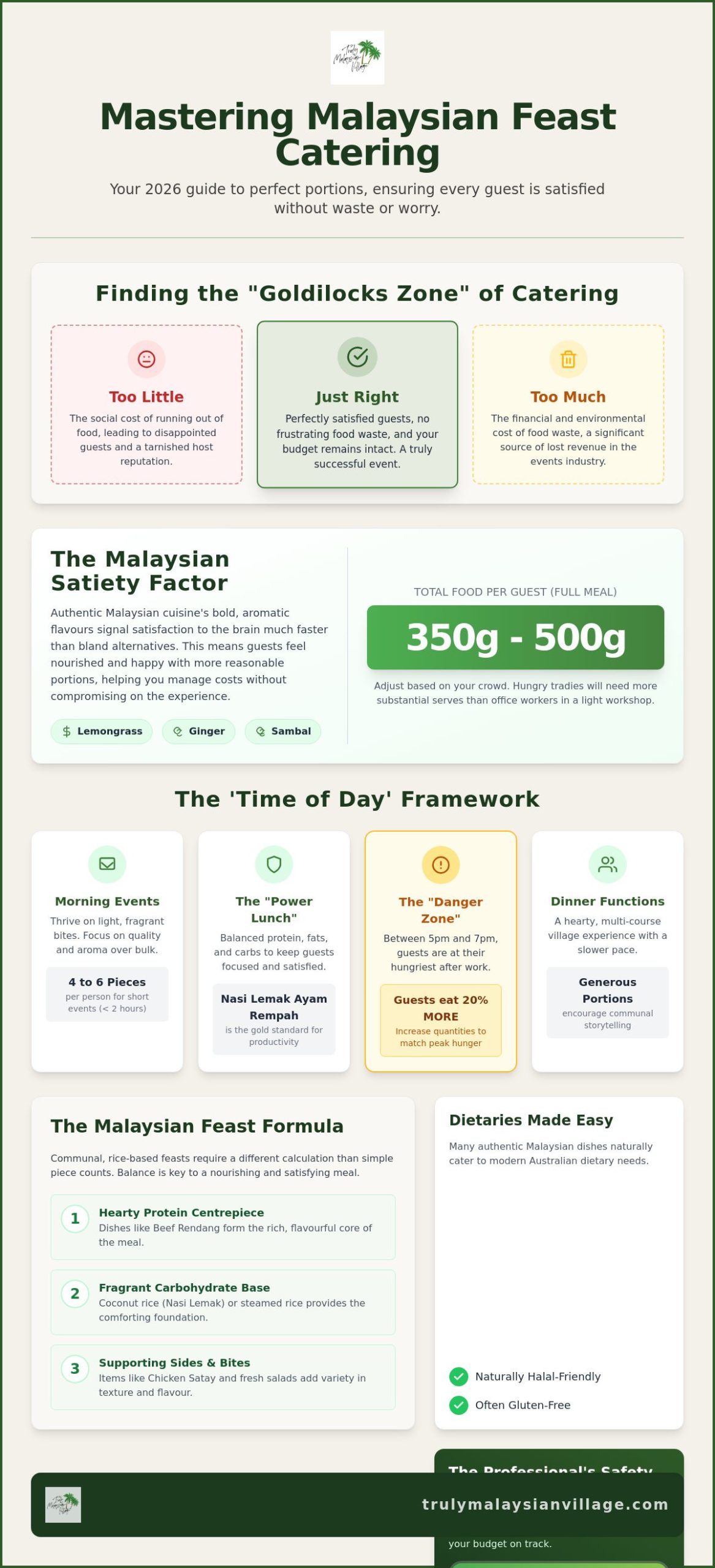
Finding the “Goldilocks Zone” of catering is a delicate dance between the soul of hospitality and the reality of a budget. You want your guests to feel cherished, as if they have stepped into a family kitchen in Penang, but you also want to avoid the heartbreak of excessive food waste. While many organisers rely on simple piece counts for cocktail parties, this logic often fails for communal, rice-based feasts. A single satay stick is a quick bite; a plate of Nasi Lemak Ayam Rempah is an experience that requires a different kind of calculation.
Australians are naturally drawn to “Visual Abundance.” When a table looks generous, guests feel more relaxed, though they often end up eating more than they technically need. However, authentic Malaysian cuisine offers a unique “Satiety Factor” that helps balance the scales. The bold, aromatic profiles of ginger, lemongrass, and our signature Sambal belacan engage the senses deeply. These complex flavours signal to the brain that the body is satisfied much faster than bland, processed alternatives, helping you manage how much food to order for catering without overspending.
Standard Portion Sizes vs. Realistic Appetites
A reliable starting point is the 350g to 500g rule, which represents the total weight of food a guest typically consumes during a full meal. While these official serving size definitions provide a useful baseline, you must adjust for your specific crowd. A group of hungry tradies on a job site will require more substantial serves of Beef Rendang than a team of office workers attending a light workshop. Portion control is best defined as the artful balance of high-quality protein, fragrant starch, and fresh vegetables to ensure every guest feels truly nourished.
The Cost of Under-Catering vs. Over-Catering
The social cost of running out of food is high. If the Beef Rendang disappears before the last guest arrives, it leaves a lingering sense of disappointment that even the best Teh Tarik cannot fix. Conversely, the Australian event industry faces significant financial and environmental pressure from food waste, which accounts for a large portion of lost revenue each year. Professional caterers often include a small “buffer” of roughly 5 to 10 percent in their preparation. This small margin protects your reputation as a generous host while keeping your budget firmly on track.
The ‘Time of Day’ Framework: When to Order a Feast
The clock on the wall often has more to say about your budget than your guest list does. In a traditional Malaysian village, the rhythm of life follows the sun, and your event planning should do the same. Timing dictates whether a guest expects a light, aromatic nibble or a full, soul-warming meal. Understanding these shifts is the secret to knowing how much food to order for catering without leaving anyone hungry or overwhelmed.
Morning events thrive on light, fragrant bites that kickstart the day. Think of these as gentle invitations to the table, where the focus is on quality and aroma rather than bulk. However, the energy shifts as we move into the “Power Lunch.” A dish like Nasi Lemak Ayam Rempah is the gold standard for corporate productivity. It provides a balanced harmony of protein, healthy fats, and complex carbohydrates, keeping guests focused and satisfied throughout the afternoon session.
As the sun begins to set, you enter what we call the “Danger Zone.” Between 5 pm and 7 pm, guests typically eat 20% more than at any other time. They have finished their workday, their blood sugar is low, and they likely haven’t had dinner yet. If your event falls in this window, you must increase your quantities to match this peak hunger. For later dinner functions, the mood transitions into a hearty, multi-course village experience where the pace is slower and the portions are more generous to encourage communal storytelling.
Calculating for Short Events (Under 2 Hours)
For social mixers or brief workshops, the goal is ease of movement. We recommend the 4 to 6 piece rule for light refreshments. Focus on hand-held items like our Chicken Satay, which allows guests to mingle and talk without the need for a formal table setting. In these shorter timeframes, variety is more important than sheer volume. Providing a few different textures and flavours will make the spread feel abundant and thoughtfully curated.
Full Meal Replacement Strategies (Over 2 Hours)
When your event spans the traditional dinner or lunch hour, you are providing a full meal replacement. This requires a methodical approach to ensure the balance is just right. If you are planning a corporate gathering, you can explore our catering packages to see how these steps come together in practice:
- Step 1: Identify the ‘Hero’ Protein. Choose a signature dish like Beef Rendang or Ayam Rempah as the centrepiece.
- Step 2: Calculate the ‘Base’. Plan for approximately 1.5 cups of cooked rice per person to provide a satisfying foundation.
- Step 3: Add the ‘Sides’. Include vegetables, Sambal belacan, and crackers to provide the necessary crunch and heat.
- Step 4: Factor in ‘The Sweet Finish’. Round out the experience with Malaysian kuih-muih for a delicate, sugary conclusion.
The Malaysian Feast Formula: Ratios for Rice, Rendang, and Satay
Planning a Malaysian spread requires a departure from standard Western buffet logic. While a typical BBQ might focus on the sheer number of sausages or sliders, a village-style feast is an intricate balance of textures and heat. The secret to mastering how much food to order for catering lies in the harmony between the ‘Hero’ dish and its supporting cast. In Malaysian culture, food is a language of love, and running out of a signature curry is like leaving a sentence unfinished.
The ‘Protein-to-Carb’ ratio is your most vital metric. Because dishes like Beef Rendang are incredibly rich and slow-cooked to a dense, aromatic perfection, guests don’t need a massive portion to feel satisfied. However, they will eat more rice than you might expect to balance the bold spices. We recommend a ratio that ensures the Rendang lasts as long as the rice, preventing that awkward moment where guests are left with a plate of plain grains and no gravy to bind them together.
Satay serves as the perfect cultural icebreaker for any Australian gathering. For a starter, 3 to 4 skewers per person is the magic number. This provides enough for everyone to enjoy the charred, smoky flavour without spoiling their appetite for the main event. Don’t forget ‘The Condiment Factor’ either. A generous supply of Sambal belacan, roasted peanuts, and fresh cucumber is essential. These aren’t just garnishes; they are the soul of the dish that provides the necessary cooling and crunch.
Mastering the Mains: Rendang and Nasi Lemak
When ordering by weight, aim for 150g to 200g of cooked protein per person for a main course. This allows for a generous serving of Chicken Rendang or Beef Dendeng. Rice calculations vary depending on the style of service you choose. Nasi Lemak, with its coconut-rich fragrance, is often served in more controlled portions compared to the mountain of rice typically seen with Nasi Kandar Penang. You can explore our weekday menu for portion inspiration to see how we balance these heritage components in our own kitchen.
Street Food Sides and Snacks
If you are serving Mee Goreng Daging as a side dish alongside rice, 100g per person is usually sufficient. This adds variety without overwhelming the plate or the palate. Texture is equally important in a Malaysian feast. Ensure you have enough ikan bilis and crackers to provide that signature ‘crunch factor’ in every bite. For beverages, calculate Teh Tarik by the litre. One litre of this perfectly pulled, frothy tea typically serves four to five guests, providing a sweet, creamy finish to the aromatic journey.
Dietaries and the Guest List: Managing the Unexpected
Welcoming a diverse group of guests means preparing for a variety of needs, from gluten-free requirements to Halal preferences. In Australia, the dietary landscape has become increasingly complex, but this doesn’t have to complicate your planning. One of the quiet joys of authentic Malaysian cuisine is its natural inclusivity. Because so many of our heritage dishes are built on a foundation of rice, fresh herbs, and coconut milk, they are often naturally gluten-free and dairy-free. When you are deciding how much food to order for catering, choosing these versatile options ensures that no guest feels like an afterthought.
The “Spice Scale” is another vital consideration for a national palate that varies from the adventurous to the mild. While we take pride in the fiery kick of a traditional Sambal belacan, we recommend balancing your menu with milder heroes like Chicken Satay or Sayur Masak Lemak Putih. This approach allows everyone to find comfort at the table. To protect your reputation as a generous host, we always suggest applying the 10% Buffer Rule. Rounding up your order by ten percent accounts for those legendary “big eaters” and the inevitable surprise plus-ones who appear at the last minute.
Creating an Inclusive Menu Without the Stress
Clear signage is just as important as the flavours in the pot. Labelling each dish with its dietary profile allows guests to serve themselves with confidence, removing the need for them to constantly ask what is safe to eat. To manage spicy expectations, provide your sambal on the side rather than stirred through the main dish. This small gesture of care allows each individual to customise their own heat level, ensuring everyone enjoys the depth of the meal without the burn.
Finalising the Guest Count
The seven-day mark is the “sweet spot” for finalising your numbers. Most professional kitchens require this week-long window to source fresh ingredients and organise their preparation schedule. If you face last-minute drop-outs, don’t panic; these portions can often be repurposed into individual boxed meals for guests to take home. For a seamless experience that respects every guest’s needs, you can place your catering order online and let us handle the finer details of the feast.
The Truly Malaysian Village Approach: From Our Kitchen to Your Event
At Truly Malaysian Village, we see every event as an extension of our own family table. Translating the vibrant, bustling heritage of Penang and Kelantan into a professional Australian setting is our life’s work. We understand that deciding how much food to order for catering isn’t just a logistical hurdle; it’s a commitment to your guests’ comfort. Our approach combines time-honoured recipes passed down through generations with the freshest local ingredients, creating a bridge between the traditional Malaysian ‘kampung’ spirit and the modern dining experience.
Whether you are hosting a high-stakes board meeting in a city office or a relaxed celebration in your own backyard, we tailor every feast to suit the occasion. We don’t believe in one-size-fits-all solutions. Instead, we focus on ‘Tradition Meets Taste,’ ensuring that every catered box carries the soul of our kitchen to your venue. Our triplets-founded business thrives on the joy of sharing our culture, providing a level of care that transforms a simple meal into a lasting memory for every guest who picks up a fork or a satay skewer.
Why Nasi Lemak is the Ultimate Event Hero
Choosing a centrepiece for your menu can be daunting, but few dishes offer the versatility of our signature Nasi Lemak Ayam Rempah. It is a crowd-pleaser that scales effortlessly, whether you are feeding ten people or two hundred. You can discover the heart of our Nasi Lemak Ayam Rempah and see how its layers of coconut rice, spicy sambal, and crispy chicken create a complete sensory experience. This dish embodies the warmth of our family heritage, making your guests feel like invited friends rather than just attendees at a function.
Ready to Organise Your Feast?
If you feel confident in your guest list but need a professional hand to finalise the details, we are here to help. Getting a tailored quote is the first step toward a stress-free event. When you enquire about our professional catering services, we work closely with you to refine your flavour profile and ensure you know exactly how much food to order for catering to achieve that perfect village-style abundance. Once your date is booked and your menu is set, you can relax, knowing the aromatic heart of Malaysia is on its way to your door.
Bring the Heart of the Village to Your Next Event
Mastering the balance of a generous spread is the hallmark of a truly great host. By understanding the ‘Time of Day’ framework and applying the specific ratios of the Malaysian Feast Formula, you’ve moved beyond guesswork. You now have the clarity to navigate the unique satiety factor of aromatic spices and the inclusive nature of Halal-friendly heritage dishes. Once you’ve determined exactly how much food to order for catering, the focus shifts from logistical worry to the joy of shared connection.
At Truly Malaysian Village, our family-run team is dedicated to bringing the authentic flavours of Penang and Kelantan to your table. Whether it’s a professional corporate gathering or an intimate private celebration, our heritage recipes ensure every guest feels like a cherished member of our village. We take the stress out of the planning process, allowing you to enjoy the aromatic depth and heartfelt craftsmanship of our service. Let us organise your next authentic Malaysian feast and experience the difference that a dedicated, professional host can make. Your perfect event is just a few clicks away; we can’t wait to share our home-cooked traditions with you.
Frequently Asked Questions
How many pieces of finger food should I order per person for a 2-hour event?
You should order between 4 and 6 pieces of finger food per person for a two-hour social event. This quantity provides a light but satisfying variety for mixers where guests are moving and talking. For a more substantial feel, selecting hand-held items like our Chicken Satay ensures everyone enjoys a taste of our heritage without needing a formal table setting or heavy cutlery.
What is the standard portion size for a main meal in catering?
The standard portion size for a main meal typically falls between 350g and 500g of total food weight per person. This total includes your main protein, such as Beef Rendang, alongside fragrant rice and vegetable sides. We recommend planning for 150g to 200g of cooked protein to ensure every guest feels truly nourished and satisfied by the end of the communal feast.
How much rice should I order for a group of 50 people?
For a group of 50 people, we recommend providing approximately 75 cups of cooked rice to serve as a foundation for your meal. This calculation allows for 1.5 cups per person, which is the ideal amount to balance the rich, bold flavours of Malaysian curries. Having a generous base of coconut-infused rice ensures your guests can fully enjoy the depth of our slow-cooked Rendang and aromatic sambals.
How do I handle guests with multiple dietary requirements in one order?
Handling multiple dietary requirements is easiest when you choose naturally inclusive dishes like Nasi Lemak or Beef Dendeng, which are often gluten-free and Halal. We suggest clear signage for every platter so guests can identify safe options with confidence. Providing sauces like Sambal belacan on the side also allows individuals to manage their own heat and dietary preferences without any unnecessary stress for the host.
Is it better to have a buffet or individual pre-packed meals for corporate events?
Choosing between a communal buffet and individual pre-packed meals depends on the specific atmosphere of your corporate event. A village-style buffet creates a sense of abundance and belonging, encouraging guests to interact and share the aromatic experience together. Conversely, individual boxes are perfect for quick working lunch sessions or when you need to strictly manage specific dietary needs for each person in the room.
How much extra food should I order to ensure we don’t run out?
We recommend adding a 10% buffer to your final guest count to ensure you never run out of food. This small margin accounts for unexpected plus-ones and those guests with larger appetites, protecting your reputation as a generous and welcoming host. It is a simple, effective way to manage how much food to order for catering while avoiding the heartbreak of an empty tray.
What are the best Malaysian dishes for crowd-pleasing catering?
The most successful crowd-pleasing dishes are those that offer a balance of familiar comfort and exotic aroma, such as Chicken Satay and Nasi Lemak Ayam Rempah. These heritage recipes from Penang and Kelantan are beloved for their universal appeal and satisfying textures. Including a mild vegetable dish like Sayur Masak Lemak Putih ensures that even those with a delicate palate feel included in the village-style feast.
How much drink (like Teh Tarik or Milo Ais) should I provide per guest?
You should provide approximately 250ml to 300ml of specialty drinks, such as Teh Tarik or Milo Ais, per guest. This amount allows everyone to enjoy a full serving of these creamy, nostalgic beverages alongside their meal. When you are calculating how much food to order for catering, remember that these sweet, frothy drinks are often as popular as the main dishes themselves and add a beautiful finishing touch.

Article by
Amzar Hariz
Director of Truly Malaysian Village
Disclaimer
The content published on this website may include articles generated or assisted by AI writing tools. While we aim to provide helpful, accurate, and up-to-date information, we do not guarantee that all content is complete, error-free, or suitable for every individual situation.

