
Satay chicken can be a balanced meal, but whether satay chicken is healthy depends on the recipe, portion and what it’s served with. One chicken satay recipe provides 311 kcal per serving, while examples of satay curry range from 481 kcal with brown rice to 600 calories without rice. The difference is a reminder that the peanut sauce, cooking ingredients and accompaniments matter.
Satay chicken’s rich, savoury sauce is part of its appeal, but it can also add fat and energy to a meal. That doesn’t make satay chicken automatically unhealthy: consider the ingredients and serving size alongside the chicken’s protein.
This guide explains how to assess calories, fat and key ingredients, and compare skewers with curry-style servings. You’ll learn to judge the dish as it’s prepared, rather than relying on its name alone.
Key Takeaways
- Compare nutrition figures only when the serving size and what’s served alongside the chicken are clear.
- Look at the full ingredient list, especially the peanut sauce, oils and salty seasonings.
- Assess coconut milk by its contribution to the dish’s total fat, including saturated fat.
- Use per-skewer nutrition as a guide, then consider how many skewers make up your meal.
- Check where sweetness comes from in the marinade or sauce, and how much is added.
What is Chicken Satay?
Chicken satay pairs seasoned chicken with peanut sauce and is often served as skewers or in a curry. To assess its nutrition, check what the serving includes and whether the figures describe the chicken alone or the complete meal.
During pregnancy in Australia, choose satay made with thoroughly cooked chicken and served hot. Avoid peanut sauce if you have a peanut allergy.
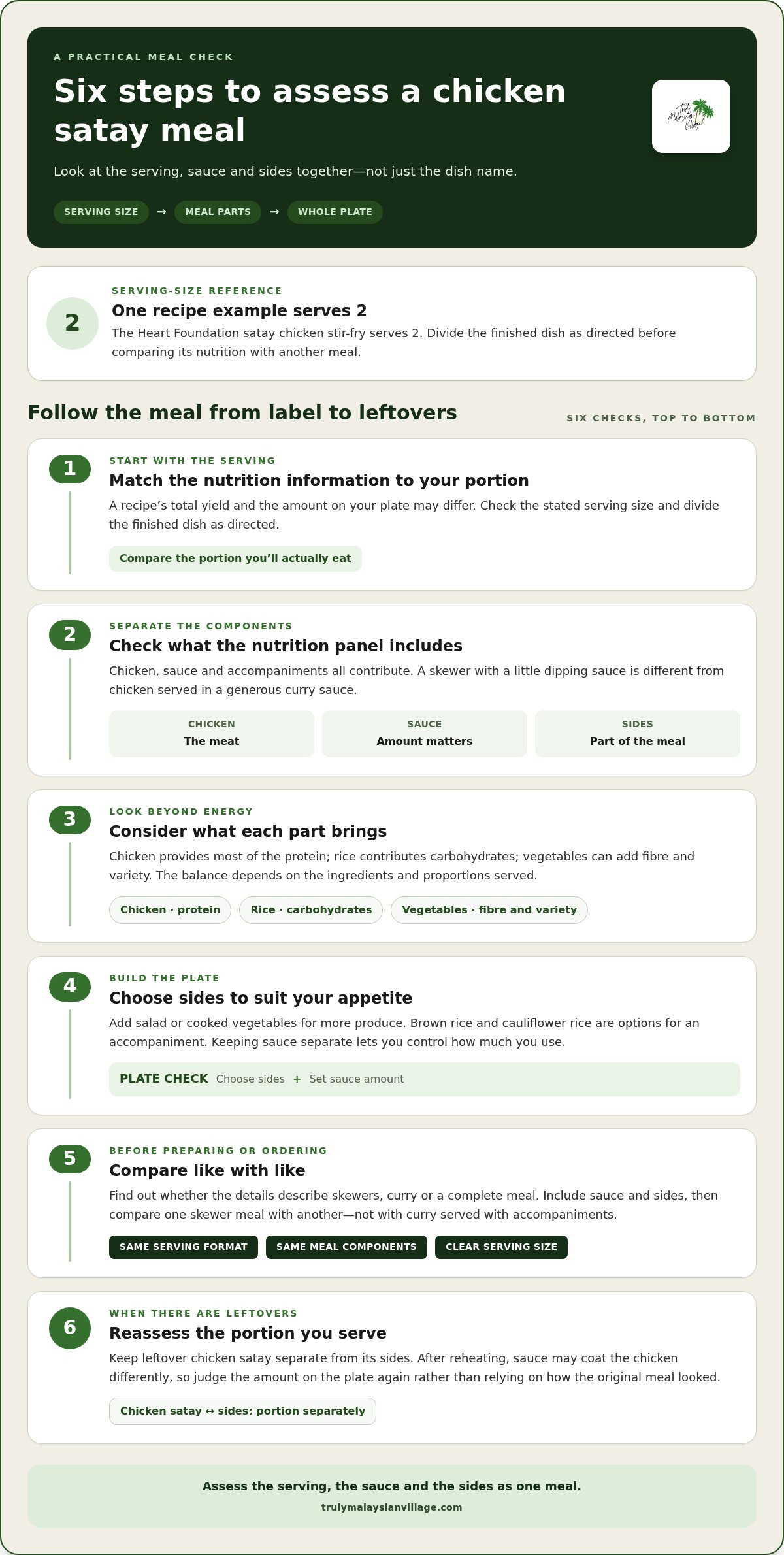
- Match the nutrition information to the serving. A recipe’s total yield and the portion on your plate aren’t necessarily the same. For example, the Heart Foundation satay chicken stir-fry serves 2. If a recipe makes several servings, divide the finished dish as directed before comparing its nutrition with another meal.
- Assess each part of the meal separately. Chicken, sauce and accompaniments all contribute to the serving. A skewer with a little dipping sauce differs from chicken in a generous curry sauce. Check which components a nutrition panel covers, then compare like with like rather than treating every dish called satay as equivalent.
- Consider more than energy. Chicken provides most of the protein, while rice contributes carbohydrates. Vegetables can add fibre and variety. Look at the whole meal rather than treating calories as the only measure of nutrition. The meal’s balance depends on the ingredients and proportions served.
- Choose sides to suit your appetite. Add salad or cooked vegetables if you want more produce alongside the chicken. Brown rice provides a grain accompaniment, while cauliflower rice is another option. Keep sauce separate if you want to control how much you use. These choices change the overall plate, even when the chicken recipe stays the same.
- Check the recipe before preparing or ordering. Find out whether the nutrition details refer to skewers, curry or a complete meal, and note the serving size. When comparing dishes, include the sauce and sides. For example, compare one skewer meal with another, rather than with curry served with accompaniments.
- Treat leftovers as a separate meal. Portion leftover chicken satay separately from its sides. After reheating, sauce may coat the chicken differently, so assess the amount you serve again rather than relying on how the original plate looked.
Chicken satay ingredients and substitutions
Peanut sauce gives satay its nutty flavour, while marinades shape the chicken’s savoury, tangy profile. Recipes vary, so assess the ingredients individually rather than assuming every satay has the same nutrition.
A satay curry serving without rice lists 20 g saturated fat and 1034 mg sodium. Those figures describe the curry serving, not peanut sauce alone.
Peanut butter poses a risk for people with a peanut allergy, and some marinades contain soy sauce. If you have concerns about gluten, check packaged ingredient labels for wheat or gluten and read any cross-contact advice.
For a home meal, choose chicken breast, measure the peanut butter and soy sauce, and add vegetables. Reduced-salt soy sauce and peanut butter made from 100% peanuts without added sugar or salt are options used in satay recipes.
- Choose the chicken and marinade deliberately. One recipe uses 1½ lb boneless, skinless chicken breasts with ¼ cup low-sodium soy sauce. It also adds 2 tablespoons peanut butter, 1 tablespoon rice vinegar, 2 teaspoons sesame oil, 2 garlic cloves and ¼ teaspoon crushed red pepper. This combination brings savoury, nutty and sharp notes.
- Compare the curry ingredients with a stir-fry. A chicken curry recipe uses 500 g chicken breast, 3 tablespoons natural peanut butter, 4 teaspoons curry powder and 2 tablespoons soy sauce. A stir-fry recipe instead uses 250 g chicken breast, 1 tablespoon peanut butter and 3 teaspoons reduced-salt soy sauce. The quantities belong to different recipes, not interchangeable portions.
- Build a dipping sauce with measured ingredients. Peanut butter forms the base; lime juice adds acidity, while water can loosen the texture. One stir-fry recipe pairs 1 tablespoon peanut butter with 2 teaspoons lime juice. Add liquid gradually, then taste before adding more soy sauce or other salty ingredients.
- Adjust the plate as well as the sauce. Add chopped vegetables such as carrot, capsicum or green beans, which are used in some satay recipes. Serve a modest amount of peanut sauce on the side, so you can control how much reaches the chicken and vegetables.
- Match substitutions to the ingredient’s role. Chicken breast provides a lean meat base in some recipes, while peanut butter gives the sauce its nutty body. Reduced-salt soy sauce can replace regular soy sauce in a stir-fry recipe. If avoiding peanuts or soy, choose a different meal rather than making a direct swap without checking every ingredient.
If you’d prefer a prepared meal, plan a meal out.
Full-fat coconut milk and saturated fat
- Read the saturated-fat figure for the whole serving. A curry serving’s saturated-fat content can vary with its recipe and portion. That figure belongs to the stated curry serving, not every satay recipe or a spoonful of coconut milk. Check whether the nutrition information covers the sauce, chicken and rice together. A serving with a different recipe or portion may have a different total.
- Compare coconut milk choices by quantity and texture. One curry recipe uses 1⅔ cups canned full-fat coconut milk, while another uses 60 ml light coconut milk. These are separate recipes, not direct swaps with matching amounts. Full-fat coconut milk gives sauce a richer body; light coconut milk can make it less creamy. The recipe’s other ingredients and serving size also shape the finished dish.
- Measure coconut milk before adding it. One chicken satay marinade recipe calls for ¼ cup of full-fat coconut milk. Measuring shows how much goes into the batch, rather than pouring freely. For a less rich sauce, choose a recipe that uses light coconut milk or calls for less. Consider the chicken, peanut butter and seasonings too: coconut milk is only one part of the finished meal.
- Build flavour with aromatics, not extra sauce. Ginger, garlic and curry spices bring warmth to chicken satay. Add them while cooking, then taste the sauce before adding more coconut milk. Chopped coriander makes a fresh garnish. These ingredients bring distinct aromas and texture, so the dish needn’t rely on a heavy coating of coconut sauce for flavour.
- Serve and reheat cooked curry thoughtfully. Spoon sauce over the chicken instead of covering every piece, so you can control how much reaches each plate. Pair the curry with vegetables for contrast, and keep rice separate when comparing portions. To reheat leftovers, warm the sauce and chicken together, stirring gently to keep the coconut-based sauce evenly mixed.
Keep the marinade and curry quantities tied to their own recipes. The recipe calls for 1/4 cup of full-fat coconut milk in the chicken satay marinade. The recipe’s curry contains 400 grams of coconut milk. These amounts describe separate preparations, so they should not be treated as equivalent measures or combined into a single serving estimate. If you are making one of them, follow its stated quantity rather than using the other recipe as a guide. When adapting a recipe, note the amount you actually add so you can compare the finished dish consistently next time.
Full-fat coconut milk adds texture as well as flavour, and the amount used affects how prominent it is in the sauce. Start with the recipe’s measured quantity, then assess the sauce once it’s mixed with the other ingredients. If it tastes too rich, serve some sauce separately so each person can choose how much to use without changing the batch. For a less creamy result, choose a recipe designed for light coconut milk; the same amount may not produce the same texture. Keep marinade quantities separate from curry quantities to see which preparation contributes coconut milk to the meal. Measure carefully rather than estimating by eye when comparing portions.
Calories and macronutrients per skewer
- Use the skewer’s own serving figures. One chicken satay skewer in a recipe lists 188 kcal, 27.8 g protein, 3.4 g carbohydrates and 6.4 g fat. It also lists 1.5 g saturated fat and 379.5 mg sodium. Treat these as figures for that recipe’s skewer, not a universal value for all chicken satay. Chicken size, marinade and cooking ingredients can change the nutrition in another version.
- Assess each macronutrient in context. The listed 27.8 g protein describes the chicken skewer, while 3.4 g carbohydrates and 6.4 g fat complete its macronutrient picture. The 188 kcal figure can help compare options only when the portion is similar. Check whether a menu or recipe figure covers the skewer alone, or includes peanut dipping sauce and sides. Those additions change what the meal contains.
- Keep sauce and sides visible in your comparison. A peanut dipping sauce can add ingredients beyond the chicken, so don’t assume the skewer’s nutrition figure covers a serving of sauce. Note whether you dip lightly or coat each piece. Record rice, salad or vegetables separately when comparing meals. This makes it easier to distinguish the skewer’s listed 379.5 mg sodium from sodium in accompanying sauce or other ingredients.
- Compare preparation details, not just the name. A recipe with chicken breast, garlic and a measured marinade may differ from skewers made with another cut or sauce. Grilling can lightly char the outside, while excess marinade may cling to the cooked chicken. To compare recipes, first match their stated serving units. Then check calories, protein, carbohydrates, total fat, saturated fat and sodium side by side.
- Track what you actually eat. Count the skewers on your plate and note any peanut dipping sauce, rice or salad. Don’t turn a per-skewer figure into a meal total without accounting for those extras. If skewers are served as part of a shared meal, estimate your own portion from the pieces you eat. For leftover cooked chicken satay, refrigerate it for up to 4 days or freeze it for up to 3 months.
Use the recipe’s daily-value context as a broad reference, not as a personalised target: its nutrition information uses general daily-value advice based on a 2100-calorie diet. That context can help frame the skewer’s listed nutrients, but it does not change the serving-specific figures or account for sauce and sides. Keep the stated portion in view when interpreting daily-value guidance.
Preparation can also help explain why a skewer may not match another version. The recipe instructs cooks to soak wooden skewers in water for 30 minutes before grilling and recommends soaking them for 30-60 minutes before grilling. Broiling is one way to cook chicken satay skewers. These directions describe that recipe’s preparation, rather than a nutrition value that applies to every skewer. When comparing nutrition, use the recipe’s serving and ingredients alongside its cooking instructions, and keep accompanying sauce outside the skewer estimate unless the stated figure includes it.
Honey and added sweetness
- Find sweet ingredients in the full recipe. Honey, brown sugar and sweet chilli ingredients can appear in marinades or sauces. One chicken satay marinade uses 2 teaspoons of honey, while another recipe adds ½ teaspoon of brown sugar. These are separate recipes, so don’t combine their amounts as though they belong to one serving. Check the ingredient list and note where each sweetener goes.
- Separate sauce sweetness from the chicken itself. A chicken satay curry serving lists 9 g sugar, but that figure describes the curry recipe’s full serving. It doesn’t tell you how much sugar comes specifically from honey, peanut sauce or another ingredient. Recipes can use different sweeteners and quantities. Compare complete recipes and serving sizes, rather than treating one sugar figure as a value for every satay meal.
- Balance sweet flavours before adding more. Soy sauce brings savoury depth, while lime juice adds sharpness. If peanut sauce already tastes sweet, stir in lime juice gradually and taste before adding honey or brown sugar. Coconut milk can make the sauce creamy and mellow, so taste again after mixing. Don’t add sweetener automatically just because a recipe lists it.
- Measure sweeteners and sauce portions. Measure honey or brown sugar with a spoon, then divide the finished recipe into its stated servings. Serve peanut sauce alongside the chicken instead of coating every piece, so diners can control how much they use. To compare calories, include the chicken, sauce and sides in the portion you assess, not just the skewer.
- Adjust sweetness without losing flavour. In a home recipe, begin with the listed sweetener, then taste the cooked sauce. Garlic, ginger, chilli and lime can add flavour alongside sweetness. If the sauce tastes too sharp, a small measured addition may round it out; if it tastes too sweet, add acidity or savoury seasoning gradually. Re-taste after each change, since soy sauce also contributes salt.
- Choose a meal with the balance you enjoy. A rich peanut sauce, coconut milk and sweet marinade can all shape the final taste and calories. For a Malaysian meal out, book a table and enjoy the flavours at their source.
Truly Malaysian Village: Nasi Lemak Ayam Rempah
Truly Malaysian Village is a welcoming next step when you’d like to enjoy Malaysian food and put your satay questions into practice. Choose Chicken Satay if you’re drawn to its familiar skewered style, or consider Nasi Lemak Ayam Rempah for a different Malaysian meal. Beef Rendang offers another distinct choice for diners who enjoy a slow-cooked dish.
Use the ingredient and portion guidance in this article to decide what suits your preferences. If you’re managing a food allergy or have specific dietary needs, discuss the relevant ingredients before ordering. Your choice can then reflect both the flavours you enjoy and the information that matters to you.
Explore the menu online or get in touch with Truly Malaysian Village to plan your meal.
Make your next meal a thoughtful choice
Food choices are easier when you know what matters to you. To decide whether satay chicken is healthy for your needs, consider how it fits your usual eating habits, preferences and dietary requirements. You can enjoy a meal for its flavour and cultural roots while choosing thoughtfully.
Let that awareness guide your next meal without turning one dish into a strict rule. You might return to the familiar warmth of Malaysian flavours or try something different. Either way, a considered choice can make the experience more satisfying.
For a welcoming taste of Malaysian cooking, plan your visit to Truly Malaysian Village. Come with curiosity, choose what appeals to you, and enjoy your next meal.
Frequently Asked Questions
Is satay chicken healthy and nutritious?
Whether satay chicken is healthy depends on how it fits your overall eating pattern and dietary needs. Treat it as one meal, not a verdict on your diet. Consider what you’ve eaten throughout the day and whether the meal suits your preferences. If you follow guidance for a health condition, use it when choosing dishes.
How many calories are in a serve of satay chicken?
There’s no single calorie figure for every serving. For a homemade batch, use the nutrition information on ingredient packaging, add up the amounts for the recipe, then divide by the portions served. If your portions differ from the recipe’s yield, calculate based on the amount you eat. This gives you a more useful estimate than a generic satay figure.
What are the protein, fat, carbohydrate, sugar and sodium levels in satay chicken?
Nutrition amounts depend on the recipe and portion, so there’s no single profile for all satay chicken. For packaged food, read the nutrition panel and use the values for the amount you eat. If you record your meals, note the product and portion together. That’s more useful than copying figures from a different recipe.
Is satay chicken healthier with grilled chicken, less sauce or extra vegetables?
Satay chicken may be a lighter choice when it’s grilled without extra cooking fat, served with sauce on the side and accompanied by plenty of vegetables. For example, choose grilled chicken with steamed greens and add sauce to taste. The result depends on preparation, so these are ways to shape your meal, not a guarantee of a particular nutrition outcome.
How healthy is peanut satay sauce, and how much saturated fat and sodium does it contain?
Peanut satay sauce can add fat and energy, so assess its ingredients and portion. No standalone figures are given for the sauce: one curry serving contains 8 g saturated fat, while a curry serving without rice lists 20 g saturated fat and 1034 mg sodium; these figures are for the whole curry serving.

Article by
Amzar Hariz
Director of Truly Malaysian Village
Disclaimer
The content published on this website may include articles generated or assisted by AI writing tools. While we aim to provide helpful, accurate, and up-to-date information, we do not guarantee that all content is complete, error-free, or suitable for every individual situation.

