
Pandan’s fragrance may suggest vanilla, but its flavour has a character all its own. If you’re wondering what pandan tastes like, expect gentle sweetness, creamy vanilla-like notes and a light nuttiness reminiscent of almond or coconut, with a fresh, grassy edge from the leaves. It’s aromatic rather than intensely sweet.
That contrast is part of its appeal: pandan adds warmth and fragrance without making a dish taste like dessert. Fresh leaves tend to have greener, more herbal notes, while cooking softens the flavour into something mellow and comforting.
In this guide, you’ll learn where pandan comes from, how its leaves flavour rice, curries and stews, and why the ingredient is treasured in desserts and cakes. You’ll also see how its sweet, fragrant side suits both savoury dishes and familiar treats.
Key Takeaways
- Pandan has a gently sweet, vanilla-like aroma with light nutty notes and a fresh, grassy edge.
- Tie or bruise the leaves before adding them to rice or liquid so they can infuse the dish as it cooks.
- Blend pandan leaves with water and strain them to create a naturally green colouring for food.
- Pandan suits savoury dishes as well as sweet treats, with coconut a natural flavour pairing.
- Fresh leaves bring greener, more herbaceous notes, while cooking softens their flavour in cakes, puddings and rice.
How can I use pandan leaves in my home cooking?
Pandan leaves are aromatic and used to flavour food and add natural green colour. Across Southeast Asian cooking, they’re added whole, steeped in liquid or blended for colouring.
Pandan features in regional cooking from Malaysia and Indonesia to Thailand and Sri Lanka, and Hainanese cuisine also uses the leaves. In the Philippines, pandan appears in sweet and savoury dishes. Fresh, dried and frozen leaves are all used; the form and preparation affect how much fragrance and colour they add to a recipe.
Pandan as an Ingredient and Colouring Agent
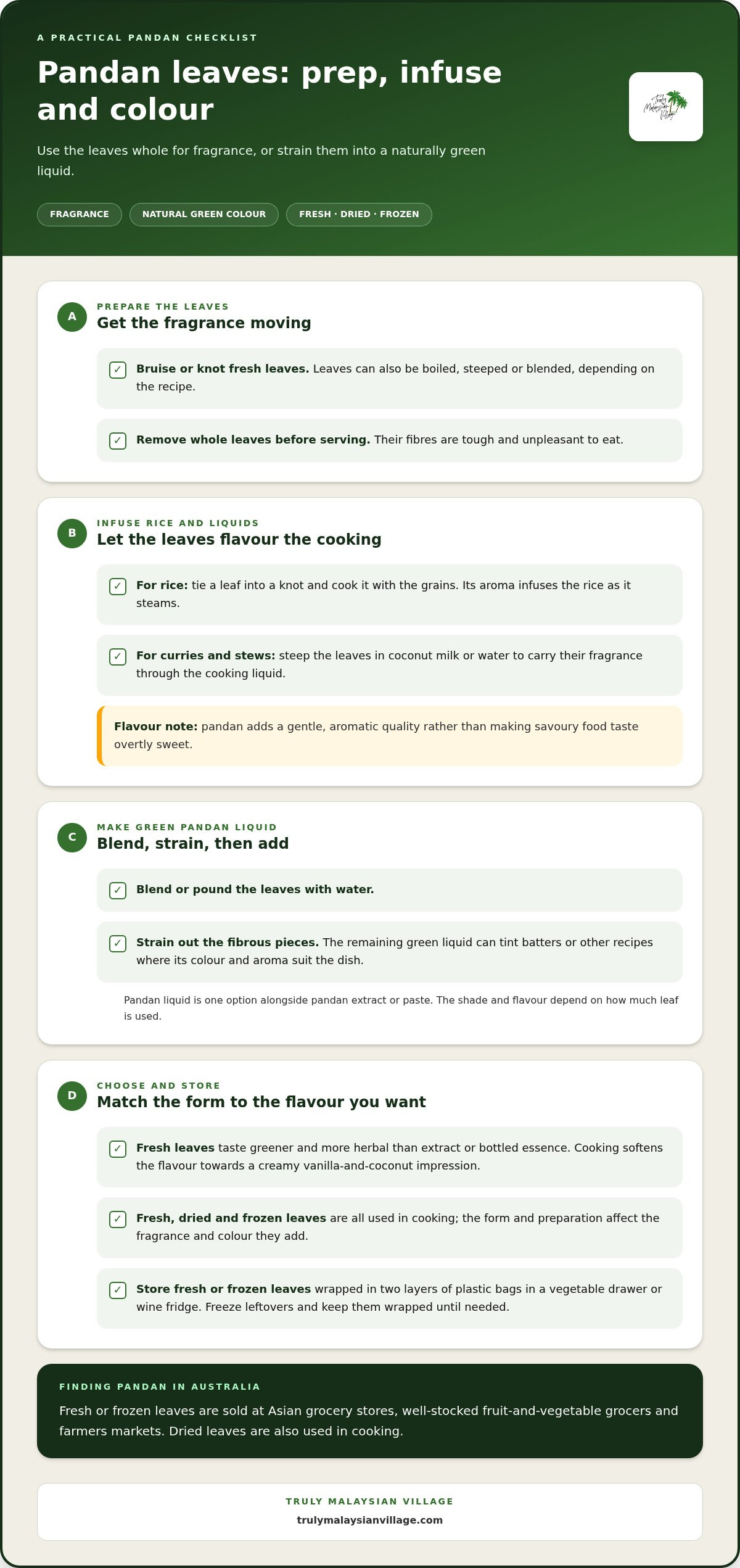
Pandan works as both a fragrant ingredient and a natural colouring agent. To colour food, blend or pound the leaves with water, then strain the mixture to separate the green liquid from the fibrous pieces. Add the liquid to batters or other recipes where its colour and aroma suit the dish. It’s another option for home cooks alongside pandan extract or paste.
Cooking with Fresh Pandan
Fresh leaves can be bruised, knotted, boiled, steeped or blended, depending on the recipe. For rice, tie a leaf into a knot and cook it with the grains. For a liquid-based dish, steep the leaves in coconut milk or water. Remove whole leaves before serving, as their fibres are unpleasant to eat. These methods infuse food with fragrance without leaving tough pieces behind.
In Australia, fresh or frozen leaves are sold at Asian grocery stores, well-stocked fruit-and-vegetable grocers and farmers markets. Dried leaves are also used in cooking. Wrap fresh or frozen leaves in two layers of plastic bags and store them in a vegetable drawer or wine fridge. Freeze any leftovers, keeping them wrapped until needed.
Fresh Leaves Compared with Extract or Paste
Fresh pandan tastes greener and more herbal than extract or bottled essence, with a slightly resinous edge. The difference matters when choosing a form: fresh leaves bring a leafy fragrance, while extract or paste gives a different expression of pandan. Pandan essence can also stand in for vanilla essence when a recipe calls for a sweet aromatic note.
How Cooking and Baking Affect Pandan
Yes, cooking and baking soften pandan’s flavour, shifting it towards a creamy vanilla-and-coconut impression. In uncooked or lightly infused preparations, the fresh leaves’ green, herbal notes may be more noticeable. That change helps explain why pandan can taste gentle in a cake or pudding but leafier when freshly blended. Choose a preparation that suits the flavour and colour you want in the finished dish.
Using pandan leaves to flavour rice, curries and stews
Pandan leaves add fragrance to savoury food without making it taste overtly sweet. Their aroma can bring gentle vanilla-like and nutty notes, along with a fresh green quality, to rice, curry sauces and stews. The tropical plant is used across Southeast Asia, including Thailand, where leaves can flavour a dish as it cooks.
In rice, a tied pandan leaf releases its aroma into the steam and grains. The result is fragrant rice with a soft, rounded flavour rather than a strong leafy taste. In curries and stews, leaves can steep in coconut milk or another cooking liquid, carrying their perfume through the sauce. Remove whole leaves before serving because their fibres are tough.
What ingredients pair well with pandan? Coconut is a natural match, especially in rice or sauces made with coconut milk. Ginger, lemon and hazelnut can also complement pandan, while vanilla echoes its sweet perfume.
Pandan’s flavour has several layers. Almond-like nuttiness sits alongside vanilla and coconut notes, while fresh leaves bring a grassy, slightly resinous quality. Some people also notice a floral character and a sweet, musky aroma. These qualities are subtle, so pandan often lends depth and fragrance rather than dominating a savoury dish.
That balance makes pandan useful in dishes with rich or gently spiced ingredients. Coconut milk softens its green edge and draws out creamy, vanilla-like notes. In a stew, the leaf’s fragrance mingles with the cooking liquid; in rice, it stays light and aromatic. Blended leaf liquid can also tint a sauce or rice preparation green. The shade and flavour depend on how much leaf is used.
Use pandan where its aroma can complement, not compete with, the other ingredients. A mild coconut-based sauce lets its floral, grassy and sweet-musky notes come through; a strongly flavoured dish may make them less distinct. For a Malaysian meal with contrasting sweet-and-sour flavours, you can book a table to enjoy Malaysian dishes.
A practical way to use pandan in rice is to knot the leaves and add them while the rice cooks, allowing their aroma to infuse the grains. In Asia, pandan is often used in ways similar to vanilla in the West, although their aromas differ. The comparison describes pandan’s fragrant role, but the two ingredients don’t smell the same. In a dish with coconut milk, the milk emphasizes pandan’s coconut-and-vanilla notes and softens its green sharpness, helping balance its fragrance.
Pandan can also flavour Hainanese chicken: bruise the leaves, tie them in a knot and add them to the dish. This is another savoury use beyond rice, curries and stews. Knotted leaves are easier to handle during cooking, while bruising prepares them to release their flavour. Whether paired with rice, coconut milk or chicken, pandan contributes aroma rather than making a dish taste strongly of the leaf. These simple methods bring the same fragrant ingredient to different kinds of savoury cooking.
Pandan in rice dishes, desserts and cakes
Pandan brings fragrance and colour to rice dishes, sweet treats and drinks across Malaysia and Indonesia. Its flavour changes with the recipe, from a light aroma in rice to a softer, creamy sweetness in baked desserts.
Pandan in Rice Dishes
In rice dishes, pandan contributes aroma as the grains cook, creating a fragrant base that complements other ingredients. Blended and strained leaf liquid can also add a green tint. The leaves are removed before serving, leaving the rice scented rather than filled with fibrous pieces. This makes pandan useful when you want fragrance without a strong, sugary taste.
Pandan in Desserts, Cakes and Kueh
Pandan is used in desserts such as coconut milk pudding, pandan pancakes and chiffon cake. In steamed pandan kueh, the cake sits on sticky glutinous coconut rice, combining soft sweetness with a chewy base. Baking or steaming mellows the leaf’s brighter notes, so the finished treat is often creamy and gently fragrant. Pandan can also colour cakes green, hinting at the flavour inside.
For drinks and dessert sauces, simmer pandan leaves in simple syrup until they turn dark green and limp, then strain them out. The fragrant syrup can flavour desserts or drinks, including cocktails, while adding a green hue. Another option is pandan water: boil the leaves with water and sugar, then serve it over ice. These preparations bring pandan’s aroma into a glass without leaving whole leaves in the drink.
What foods and drinks commonly contain pandan? Examples include pandan chiffon cake, coconut milk pudding, pancakes, kueh, rice dishes and pandan water. The leaves also flavour syrups for drinks and desserts, carrying their aroma from a cake plate to a chilled glass.
In baked recipes, pandan extract or paste can colour and flavour the mixture throughout. Leaf-infused syrup offers another way to add pandan to dessert, particularly when you want its fragrance in a topping or drink. The method affects the result: pandan in a cake is distributed through the crumb, while syrup adds flavour wherever it’s poured or stirred.
Across tropical cuisines, pandan’s role in desserts reflects how well it pairs with coconut and sweet ingredients. Chiffon cake highlights its soft fragrance, while sticky rice and pandan kueh bring together distinct textures. Served in a dessert or a glass, pandan adds a recognisable aroma and, when prepared as a green liquid or paste, natural colour.
Pandan in sweet and savoury dishes
Pandan’s fragrant, gently sweet character suits desserts, while its fresh herbal notes can lift savoury cooking. The same leaf brings a different balance depending on its role and the ingredients around it.
Pandan in Sweet Dishes
In sweet dishes, pandan adds aroma and a soft vanilla-and-coconut impression, rather than sweetness alone. Coconut milk pudding, cookies and traditional sweets show how its fragrance complements rich or sugary ingredients. In a cake, pandan can flavour the mixture throughout; in a syrup, its aroma can be added as a finishing touch. That difference helps you choose a preparation to suit the dessert.
Pandan chiffon cake is a familiar example, combining a light texture with the leaf’s distinctive fragrance. Coconut milk pudding is creamier, with coconut softening pandan’s greener notes. In pancakes and other traditional sweets, pandan can contribute both flavour and green colour. Its role varies: sometimes the aroma leads, while in other recipes the colour is just as noticeable.
Pandan also works in drinks and sweet sauces. Brew the leaves as pandan tea, or simmer them in simple syrup and strain the liquid for desserts. Stir the syrup into a drink or spoon it over a sweet dish. These uses carry pandan’s aroma beyond cakes and puddings without serving the fibrous leaves themselves.
Pandan in Savoury Dishes
In savoury dishes, pandan adds fragrance and a light herbal lift, not a sugary taste. Its leaves can wrap meat for steaming or frying, as in pandan chicken. This puts the aroma close to the food as it cooks, while the leaf acts as a fragrant wrapper. Remove the leaves before eating.
Coconut milk is a useful partner in savoury cooking because its creamy texture softens pandan’s sharper green notes. In a curry or sauce, the two create a rounded aroma without turning the dish into dessert. The leaf’s sweet perfume sits alongside savoury ingredients rather than taking over their flavour.
When cooking with pandan, consider the leaf’s role before adding it. A whole leaf can perfume meat as it cooks, while blended pandan can bring colour and aroma to a sauce. In a sweet recipe such as pudding, its vanilla-like notes feel at home; with chicken, its herbal fragrance is more prominent. These contrasts explain pandan’s place in both sweet and savoury cooking.
What does pandan taste and smell like?
To understand pandan’s sensory character, distinguish what you smell from what you taste. Its scent is often the first impression, while its flavour becomes clearer as you eat. This helps explain why people may describe the same pandan dish differently: one person might focus on its aroma, another on the taste after a bite.
Try paying attention in stages. First, notice the aroma before tasting. Then take a small bite and consider how the flavour arrives, whether it feels immediate or develops gradually, and what remains after swallowing. This gives you a more precise sense of what pandan tastes like than relying on a single comparison.
The finished dish also affects what stands out. A little pandan can sit in the background, while a more concentrated preparation makes its signature easier to notice. Other ingredients influence the balance, too. A rich or strongly seasoned dish may draw attention away from pandan, while a simpler preparation gives its character more room.
Describe pandan with sensory terms rather than comparing it with just one ingredient. Consider its intensity, how long the aroma lingers, and whether the taste feels rounded or sharp. These observations help you decide whether you enjoy pandan in a particular recipe, even if your description differs from someone else’s.
Smell can shift as food cools. A warm dish releases its aroma differently from one served at room temperature, so the first impression may not be the last. Notice whether the scent changes from serving to eating, and whether the flavour stays present or fades. This simple comparison can make pandan easier to recognise in unfamiliar food.
For a clearer tasting, try pandan in a plainly prepared item before moving on to a more complex dish. Keep the first sample small, pause between bites, and focus separately on the aroma, flavour and aftertaste. There’s no need to settle on one perfect description. Sensory language is personal, and noticing what stands out to you can guide your preferences.
If you’d like to explore Malaysian cooking around the table, book a table.
The pandan leaves tried had almondy, vanilla-like, caramel-like, creamy, umami, slightly grassy and floral flavours. Pandan leaves produce the volatile compound 2-acetyl-1-pyrroline as they wither and a yellow pigment breaks down.
Pandan’s characteristic aroma is caused by the compound 2-acetyl-1-pyrroline, linking its scent to a specific volatile compound.
Truly Malaysian Village: Nasi Lemak Ayam Rempah
Truly Malaysian Village offers a welcoming way to explore Malaysian flavours through dishes such as Nasi Lemak Ayam Rempah. If pandan has sparked your curiosity about the ingredients and aromas of Malaysian cooking, enjoy this savoury dish as part of your discovery. The menu also includes Beef Rendang and Chicken Satay, giving you other familiar Malaysian favourites to try.
Pandan’s distinctive fragrance is one part of a broader food tradition, where herbs, spices and carefully prepared dishes bring depth to the table. Choose a meal for yourself or share it with family and friends. TMV Gift Cards are another way to share a taste of Malaysian cooking.
You’re welcome to visit trulymalaysianvillage.com and explore the menu.
Let your next meal lead to a new flavour
Understanding what pandan tastes like is a starting point, not a final verdict. Your impressions can grow as you encounter new ingredients and food traditions, so stay curious and let each meal offer a fresh perspective. A flavour that feels unfamiliar today may become a welcome part of your food vocabulary.
Curiosity about pandan can lead to exploring the wider story of Malaysian cooking. Sharing a meal gives you space to explore at your own pace, notice what interests you and discover dishes that are new to you. There’s always another flavour to meet.
If you’d like to continue exploring Malaysian food, you’re warmly invited to contact Truly Malaysian Village.
Frequently Asked Questions
What is pandan?
Pandan is the common name for a tropical plant also known as screwpine. In food writing, the name may refer to the plant, its leaves, or the flavour they impart. If a recipe simply says “pandan”, check the surrounding instructions: a whole leaf, blended liquid and prepared flavouring are used differently, even though each brings pandan character to the dish.
What flavours are commonly compared to pandan?
Vanilla, almond and coconut are common reference points for describing pandan. They’re useful starting comparisons, not exact substitutes for its overall character. For a more personal description, notice which quality comes through first, then whether the finish changes. A pandan dessert and a savoury preparation may leave different impressions because the other ingredients shape the tasting experience.
Is pandan taste sweet, grassy, or vanilla-like?
Pandan can have a gentle sweetness, but it isn’t simply a sweetener. Its taste may also seem leafy, and some people compare part of its character with vanilla. The balance varies across recipes, so consider the whole dish rather than judging the ingredient from one bite. A recipe with added sugar may taste sweeter overall without making pandan itself taste sugary.
What is pandan, and which part of the plant is used for flavour?
Pandan is a tropical plant, and its long leaves are used to flavour food. In a recipe, leaves may be tied into a bundle for infusion or processed to release their flavour into a mixture. This distinction is practical: whole leaves can be lifted out after cooking, while blended pandan becomes part of the preparation. The method described in the recipe indicates which form to use.
Is pandan flavour similar to vanilla, coconut, or matcha?
Pandan has some similarities to vanilla and coconut, but neither describes it completely. Matcha is different: it’s powdered green tea, while pandan is a plant used to flavour food. A green colour alone doesn’t make a dessert taste like matcha. For a recipe, choose pandan when you want its distinct Southeast Asian culinary character rather than a tea flavour.

Article by
Amzar Hariz
Director of Truly Malaysian Village
Disclaimer
The content published on this website may include articles generated or assisted by AI writing tools. While we aim to provide helpful, accurate, and up-to-date information, we do not guarantee that all content is complete, error-free, or suitable for every individual situation.

