
What if the secret to Malaysia’s most beloved dish isn’t found in a prestigious kitchen, but in the accidental genius of a village legend and a pot of spilled coconut milk? Many of us have shared a laugh over a steaming plate of “fat rice” while worrying that the true, soulful story of the meal is being buried under generic fusion trends. It can be a real struggle to find those fair dinkum Malaysian flavours in a modern landscape that often prioritises style over the substance of heritage.
In this article, we’ll dive deep into the history of nasi lemak to uncover the fascinating legends, colonial records, and rural roots that shaped this national treasure. You’ll discover how a humble farmer’s breakfast transformed into a world-renowned culinary icon. We’ll explore the “village soul” of the dish, helping you identify the hallmarks of an authentic recipe and appreciate the dedicated craftsmanship involved in creating the perfect sambal. Join us as we honour the legacy of a meal that brings a sense of home and belonging to every table it graces.
Key Takeaways
- Uncover the meaning behind “fat rice” and why this fragrant staple remains the undisputed heart of Malaysian culture.
- Explore the enchanting legends and colonial records that define the history of nasi lemak as it moved from coastal villages to the national stage.
- Master the hallmarks of authenticity, from the perfect fluffy texture of pandan rice to the rich, slow-cooked craftsmanship of a proper sambal.
- Discover how time-honoured traditions keep the “village soul” alive, ensuring every serve delivers a sense of home-cooked familiarity and warmth.
The “Fat Rice” Mystery: What Exactly is Nasi Lemak?
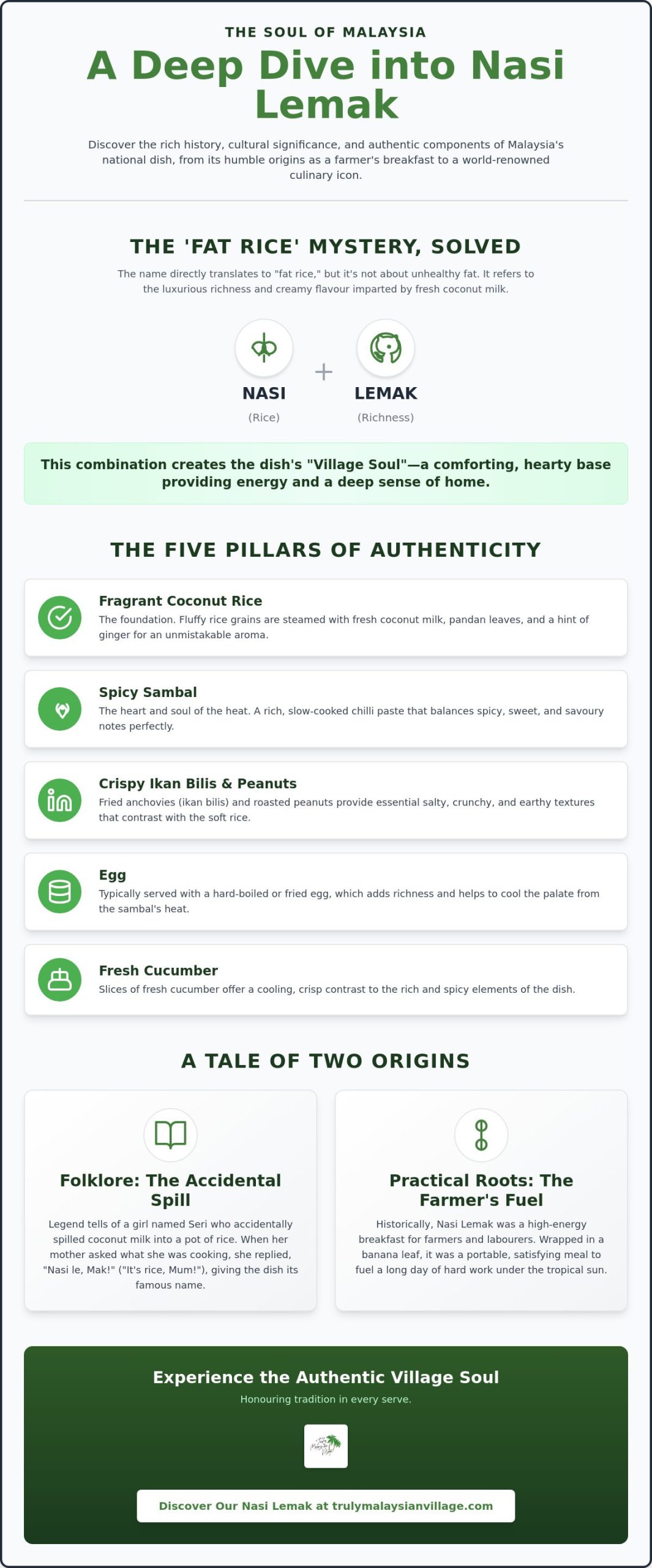
Before we can truly appreciate the history of nasi lemak, we need to understand what makes this dish the undisputed soul of Malaysia. It is more than just a meal; it’s a cultural anchor that brings together people from all walks of life. The literal translation often raises a few eyebrows among the uninitiated. “Nasi” simply means rice, while “Lemak” translates to fat or richness. While that might sound a bit heavy to a health-conscious Aussie, it isn’t about the sort of fat you’d find on a steak or in a deep fryer. Instead, it refers to the silky, creamy texture and deep flavour profile achieved by soaking the grains in fresh coconut milk.
This richness is what we call the “Village Soul”. It represents the heart of the community and the resourcefulness of the people who first created it. In the early days, Nasi Lemak was the ultimate fuel for the hardworking soul, providing the energy needed for a long day in the paddy fields or out at sea. It’s a dish born from the land, using simple ingredients to create something that feels like a warm hug from your grandmother.
The Anatomy of an Authentic Village Staple
A proper plate is built on five essential pillars that must live in perfect harmony. You have the fragrant coconut rice, the spicy kick of the sambal, the salty crunch of fried ikan bilis (anchovies), the earthiness of roasted peanuts, and the cooling presence of a boiled or fried egg. It’s a masterclass in balance. Every mouthful offers a contrasting dance between spicy and sweet, or crunchy and creamy. Historically, this wasn’t just a sit-down affair. It was a portable brekkie, wrapped tightly in a banana leaf so labourers could carry their sustenance into the fields with ease. This humble packaging kept the rice moist and infused it with a subtle, earthy aroma.
Why “Lemak” Matters to the Flavour Profile
The magic happens when the coconut milk meets the aromatics. We use pandan leaves and ginger to create that signature “village” scent that hits you before you even take a bite. This fragrant richness is vital because it acts as the perfect foil for the intense heat of a well-made sambal. Without that creamy base, the spice would overwhelm the palate. “Lemak” is a culinary term for a specific type of richness and depth derived solely from the use of coconut milk. It’s the secret ingredient that transforms a simple bowl of rice into a national icon, providing a sense of comfort that resonates with anyone who has ever called Malaysia home.
Folklore and Foundations: The Legend of the Accidental Spill
In the quiet corners of a traditional kampung, stories are often as rich as the food itself. One of the most cherished tales in the history of nasi lemak involves a young girl named Seri and her mother, Mak Kuntum. As the legend goes, Mak Kuntum was busy with her chores, leaving Seri to look after the rice pot. In a moment of distraction, Seri accidentally spilled coconut milk into the bubbling water. Instead of a disaster, the kitchen was soon filled with an intoxicating, creamy aroma that brought her mother running. Surprised by the scent, Mak Kuntum asked, “Apa kau masak ni, Seri?” (What are you cooking, Seri?). Seri simply replied, “Nasi le, Mak!” (It’s rice, Mum!). This playful exchange is said to have given the dish its name, capturing the accidental genius that often defines village cooking.
The Farmer’s Breakfast: A Practical Origin
While the legend warms the heart, the practical foundations of the dish are found in the hard work of the paddy fields. Nasi Lemak was originally a high-energy meal designed to sustain farmers through hours of intense labour under the tropical sun. It was the ultimate example of kampung resourcefulness. Every ingredient was sourced from the immediate village environment. Coconuts provided the rich milk for the rice and the oil for frying. Pandan leaves, growing wild behind the wooden houses, were plucked to add their signature fragrance. It was a meal born of necessity, using the land’s bounty to create something both portable and incredibly satisfying.
A Dish of Shared Memories
These stories do more than just explain a recipe; they weave a tapestry of nostalgic warmth that we strive to honour every day. For many, the scent of coconut rice is a time machine. It takes them back to their childhood home, where the kitchen was the heart of the family and every guest was treated like kin. We believe in preserving this legacy of heartfelt craft. You can see how we bring this to life in our guide to Authentic Nasi Lemak Ayam Rempah in Adelaide: A Taste of Home. It’s about more than just food. It’s about sharing a piece of our history with you. If you’re feeling a bit hungry for a taste of tradition, you might want to reserve a table with us and experience that village soul for yourself.
From Coastal Villages to National Icon: A Timeline of Taste
The journey of this dish from the edge of the jungle to the global stage is a story of cultural pride and quiet persistence. In the early 20th century, it was strictly a local secret, shared amongst neighbours in coastal communities. As the decades rolled on, this humble brekkie migrated from the kampung to the city, eventually finding its way into the hearts of people all over the globe. It is a narrative that mirrors the growth of a nation, moving from rural roots to urban prominence without ever losing its essential character.
The 1909 Milestone: “The Circumstances of Malay Life”
Sir Richard Winstedt, a British scholar, provided the first formal Western written record of the dish in 1909 when he described rice cooked in coconut milk in his work, “The Circumstances of Malay Life”. This colonial record did not invent the dish, but it certainly validated the sophisticated methods that village cooks had already been using for centuries. This recognition was a turning point in the history of nasi lemak, helping the broader world understand that this was a distinct and highly crafted culinary art form rather than just a simple rural snack.
After Malaysia gained independence in 1957, the meal took on a new level of significance. It became a powerful symbol of national identity, a dish that every citizen could claim with pride regardless of their background. During the mid-20th century, the rise of street food culture saw vendors selling the iconic banana leaf “bungkus” (packets) on almost every corner. These small, triangular bundles provided a quick, nutritious meal for workers on the go. Eventually, these simple packets evolved into the elaborate platters we see today, which often include rich sides like fried chicken, allowing the dish to move from the pavement to the restaurant dining room while keeping its village soul intact.
Regional Cousins Across Southeast Asia
The history of nasi lemak also sits within a wider family of Southeast Asian rice dishes, such as Nasi Uduk from Jakarta and Nasi Liwet from Java. While these cousins share the use of coconut milk, the Malaysian “Village” style is unique because it prioritises a specific balance of spicy-sweet sambal and crunchy anchovies. As people migrated, they carried these recipes across the seas to places like Australia. This movement has ensured that the “village soul” of the dish remains alive and well, offering a taste of home-cooked familiarity to everyone who sits down at our table to enjoy the weekday menu.
The Evolution of Authenticity: How to Spot a Proper Nasi Lemak
Understanding the history of nasi lemak is one thing, but knowing how to spot a truly authentic serve is where the real joy begins. In an era where fusion often muddies the waters, looking for specific hallmarks of quality ensures you’re tasting the “village soul” we’ve discussed. It starts with the rice. Each grain should be distinct and fluffy, never clumping together in a mushy mess. When you lean in, you should be greeted by the delicate, floral scent of pandan and the subtle warmth of ginger; a fragrant reminder of the traditional kampung kitchen.
The accompaniments are just as vital for that fair dinkum experience. The anchovies must have a serious crunch that stands up to the rice, while the peanuts should be deeply roasted to a golden brown, never left to turn bitter or burnt. While the history of nasi lemak began with simple village ingredients, the modern era has embraced the Nasi Lemak Ayam Rempah. This spiced fried chicken, marinated with aromatics like lemongrass and turmeric, has become the ultimate partner for the coconut rice. It offers a crispy, savoury contrast that rounds out the meal perfectly, bridging the gap between historical roots and modern cravings.
The Sacred Art of the Sambal
If the rice is the body, the sambal is undoubtedly the soul. A shortcut sambal, made in minutes with too much sugar and not enough patience, completely ruins the historical integrity of the dish. A proper sambal requires hours of slow-cooking until the oil separates from the spice paste, a process known as pecah minyak. This technique develops a complex profile where the heat of the chillies is tempered by a gentle sweetness and the deep, savoury umami of quality belacan (shrimp paste). You can see how this level of craftsmanship transforms our Truly Malaysian Village Menu into a genuine cultural experience.
Why Banana Leaves Still Matter in 2026
Even as we move through 2026, the humble banana leaf remains a non-negotiable for authenticity. It isn’t just for show. The leaf acts as a natural thermoregulator, keeping the rice at the perfect temperature while imparting a subtle, tea-like aroma that plastic or paper simply can’t replicate. This “village” method is a cornerstone of our Malaysian Catering Services, ensuring that even at a large event, the food retains its home-cooked familiarity. If you want to experience this dedication to heritage firsthand, we invite you to book your table today and taste the difference that tradition makes.
Bringing the Village Soul to Australia: The Truly Malaysian Way
At Truly Malaysian Village, we reckon that the best way to honour the history of nasi lemak is to keep its soul alive in every grain of rice we steam. We aren’t just serving a meal; we are inviting you into our family’s heritage. Our kitchen is a place where time slows down, allowing us to focus on the heartfelt craft that defines traditional kampung cooking. Every plate of Nasi Lemak Ayam Rempah we serve is the logical conclusion of a centuries-old journey, brought to life right here in Australia. It’s a history you can taste, prepared with the same dedication that village cooks have shown for generations.
Preserving the Craftsmanship of the Kampung
Our commitment to heritage means we never take shortcuts. We believe that the love and care poured into a dish can be tasted in every bite. From the rhythmic, skilled motion of pulling a frothy Teh Tarik to the patient, slow-frying of our Rempah chicken, we stay true to the methods passed down through our elders. This dedication ensures that our food retains that elusive home-cooked familiarity that can be so hard to find far from home. If you have a mate who appreciates authentic flavours and a good story, our TMV Gift Cards are a brilliant way to share this piece of history with them.
A Taste of Home for Every Aussie
We see ourselves as cultural ambassadors, bridging the gap between our deep Malaysian roots and the vibrant Australian dining scene. It’s about creating a space where everyone feels they belong, regardless of where they grew up. By staying faithful to the authentic Southeast Asian flavours found in the history of nasi lemak, we offer more than just sustenance. We offer an experience that transports you to a simpler time. We want every guest to feel like they’ve been invited into a family home in the heart of a kampung. Whether you want to join us in person or bring the village soul to your next big event, we are ready to host you. Book your village experience or order catering today to taste the legacy for yourself.
Savour the Legacy of the Kampung
The history of nasi lemak is far more than a collection of dates and legends; it is a living testament to the resourcefulness and heart of the Malaysian people. We have journeyed from the accidental genius of a village kitchen to the sophisticated, aromatic platters that define a nation’s identity. You now know that a proper serve relies on the harmony of fluffy coconut rice and the slow-cooked craftsmanship of a rich, soul-warming sambal. These aren’t just ingredients; they are the building blocks of a cultural legacy that we are proud to share.
Since 2020, we have served as dedicated cultural ambassadors, bringing these nostalgic, home-cooked flavours to the Australian community. Our Nasi Lemak Ayam Rempah is prepared with traditional methods that evoke a deep sense of belonging and comfort with every bite. We invite you to join us and experience this “history you can taste” firsthand. Experience the authentic taste of the village—view our Nasi Lemak menu and book your table here. We can’t wait to welcome you into our home and share a meal that truly feels like home.
Frequently Asked Questions
What is the literal meaning of Nasi Lemak?
Nasi Lemak literally translates to “fat rice” in Malay, but this refers to the rich and creamy texture of the dish rather than dietary fat. The name describes the silky mouthfeel the grains take on after being soaked and steamed in fresh coconut milk. This richness is the heart of the meal, providing a decadent base that perfectly balances the spicy kick of the accompanying sambal.
Is Nasi Lemak originally from Malaysia or Singapore?
Nasi Lemak is the undisputed national dish of Malaysia, with its origins firmly rooted in the traditional Malay fishing and farming communities of the peninsula. While it’s a beloved staple in Singapore due to shared cultural history, the dish’s identity is inextricably linked to the Malaysian “kampung” or village soul. It represents the resourcefulness of Malaysian ancestors who used local coconut and pandan to create a sustaining meal.
Why is Nasi Lemak traditionally wrapped in a banana leaf?
The traditional banana leaf wrap serves as a natural thermoregulator and an aromatic infusion for the warm rice. Beyond being a biodegradable plate, the leaf imparts a subtle, tea-like fragrance that enhances the overall sensory experience. In the early history of nasi lemak, this “bungkus” style was a practical necessity for farmers, keeping their breakfast portable and fresh while they worked under the tropical sun.
What are the essential components of an authentic Nasi Lemak?
An authentic serve must include five essential pillars: coconut-infused rice, spicy sambal, fried anchovies (ikan bilis), roasted peanuts, and a boiled or fried egg. Fresh cucumber slices are also standard to provide a cooling contrast to the spice. These components represent a masterclass in flavour balance, offering a dance of salty, sweet, crunchy, and creamy textures that have remained consistent throughout the centuries-old history of nasi lemak.
Who is Sir Richard Winstedt and what is his connection to Nasi Lemak?
Sir Richard Winstedt was a British scholar who provided the first formal Western written record of the dish in 1909. In his work, “The Circumstances of Malay Life”, he documented the sophisticated method of cooking rice in coconut milk. While village cooks had already perfected the recipe for generations, his record helped validate the dish as a distinct and highly crafted culinary art form to the wider world during the colonial era.
What is the “accidental spill” legend of Nasi Lemak?
The “accidental spill” is a popular village legend featuring a young girl named Seri and her mother, Mak Kuntum. While Seri was looking after the rice pot, she accidentally spilled coconut milk into the bubbling water, creating a fragrant aroma that surprised her mother. When asked what she was cooking, Seri replied, “Nasi le, Mak!”, which playfully evolved into the name we know today. This story highlights the accidental genius found in kampung kitchens.
Is Nasi Lemak a breakfast dish or can it be eaten for dinner?
Nasi Lemak began its life as a high-energy breakfast for farmers, but it’s now enjoyed at any time of the day or night. In Malaysia, you’ll find it served as a quick morning “bungkus” on the street or as an elaborate dinner platter accompanied by rich sides like Beef Rendang. This versatility is part of its charm, making it a comforting staple for a late-night supper just as much as a sunrise start.
What makes the sambal in Nasi Lemak so special?
The sambal is considered the “soul” of the dish because of the intense craftsmanship required to achieve a complex flavour balance. A proper sambal must be slow-cooked for hours until the oil separates, a technical stage known as “pecah minyak”. This process ensures the heat of the chillies harmonises with the deep umami of belacan (shrimp paste) and a hint of sweetness, creating a sauce that complements rather than overwhelms the rice.

Article by
Amzar Hariz
Owner of Truly Malaysian Village
Disclaimer
The content published on this website may include articles generated or assisted by AI writing tools. While we aim to provide helpful, accurate, and up-to-date information, we do not guarantee that all content is complete, error-free, or suitable for every individual situation.

